Version 4: a pitch for workshops
Honor the Complaint
Honor the Complaint
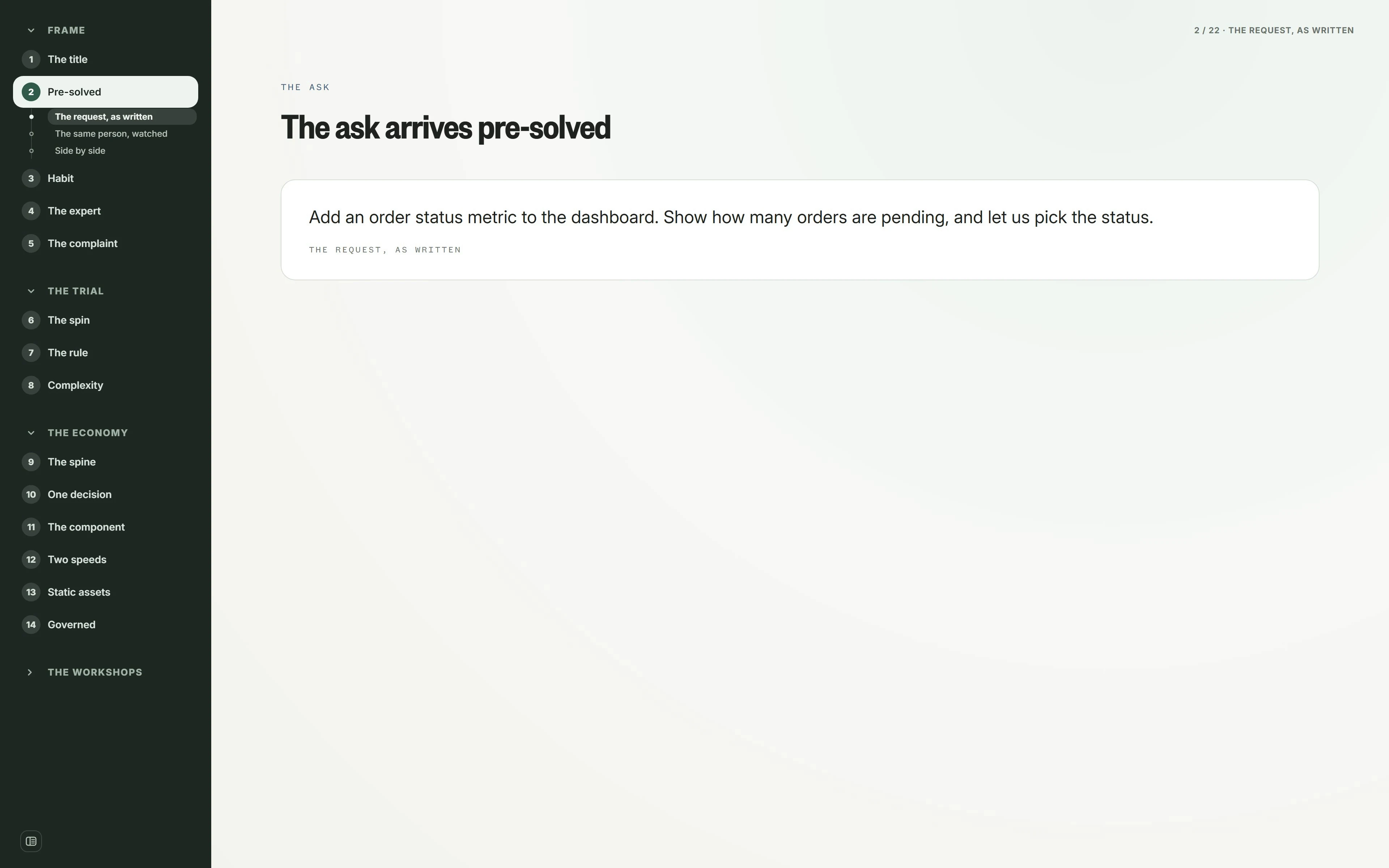
A request arrives written as a solution: add a metric that shows how many orders are pending. In the deck it gets built exactly as asked and passes review. The next card shows the rep with the new metric on screen, still sorting every order by hand to work out which can move, which are stuck and which buyer to call first. The ticket asked how many; the morning’s question was which.
Honor the Complaint is the fourth version of the presentation, and the first that ends in a proposal. The doctrine is one line: “We honor the complaint. We fix what made them ask.” Every decision then gets taken for a spin on a test track, which the deck describes as a prototype and research facility where good ideas get validated and bad ones get remembered. Decisions that survive ship once, as shared definitions and components, so nobody re-decides light grey. Then comes the ask: six workshops, from personas to what reaches the screen, each showing the artifact it leaves and what the team keeps.
Most slides carry a drawing, and a filled dot that stands for a decision moves through four of them without the deck ever pointing at it. The right arrow steps forward, 54 steps across 22 slides. It closes on how I’d know it failed and one question: “Which decision is open right now?”
I stopped working on it when I decided to rebuild the pitch around a single diagram, the Wisdom WheelWisdom WheelMy approach to product design, drawn as one chart: users at the center, the practice around them, and a ring of settled conclusions that grows.. The six workshops became the Workshop SeasonWorkshop SeasonSix one-hour workshops I ran for coworkers inside a company that doesn’t exist, where everyone played an employee and left curious about their customers’ days..